
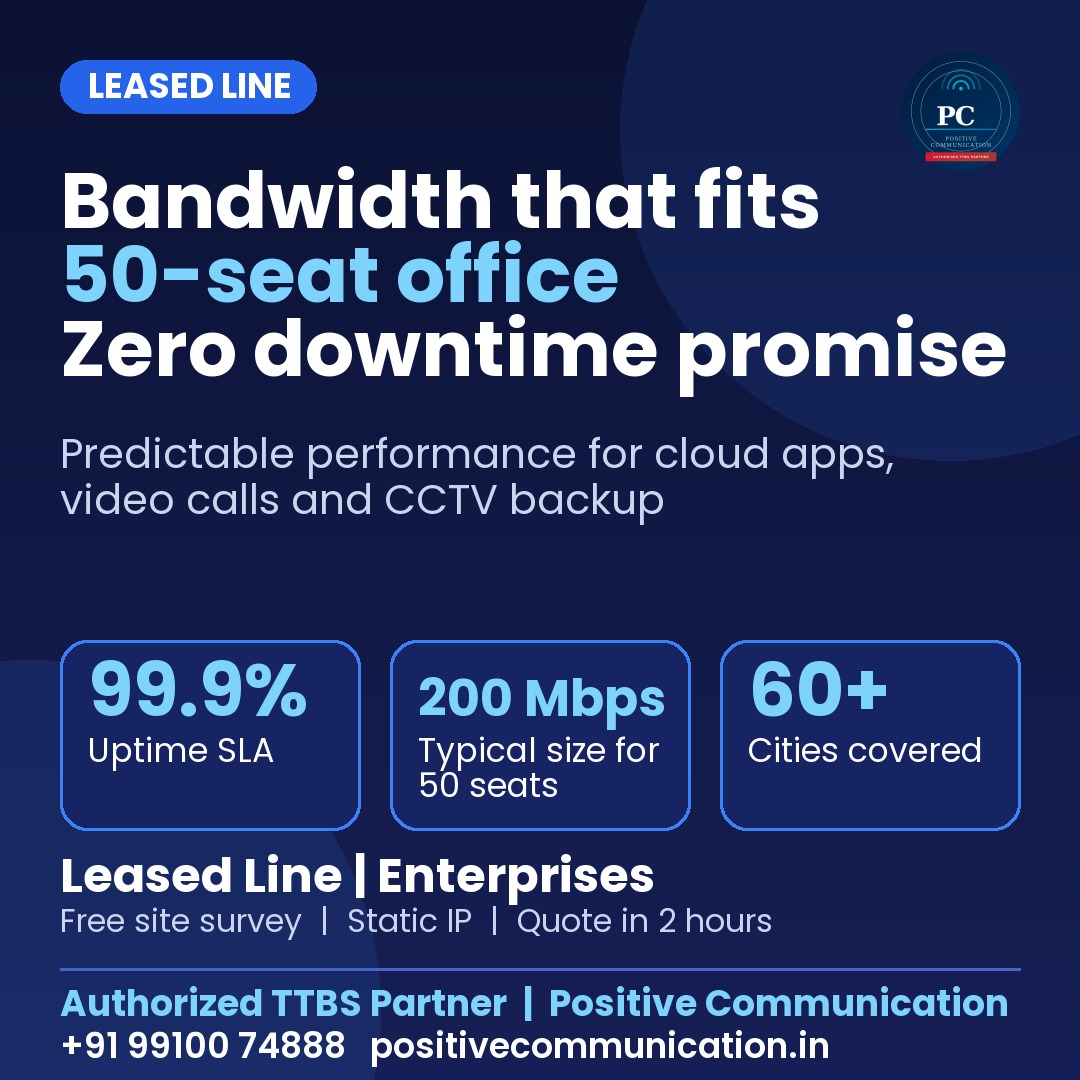
A Gurgaon‑based digital marketing agency just hired 20 new designers, bringing its headcount to 50. Within a week the team noticed lag on Adobe Creative Cloud, choppy Zoom meetings and delayed uploads of CCTV footage to the cloud. The existing broadband pipe (20 Mbps) was clearly a bottleneck, but the CFO was wary of overspending on a massive pipe that might sit idle at night.
Why bandwidth planning matters for a 50‑seat office
When every employee opens multiple cloud apps, participates in video conferences and the security team streams CCTV to an off‑site server, the network behaves like a busy highway. If the lane width (bandwidth) is too narrow, traffic jams appear as latency, packet loss and missed calls. Over‑provisioning, on the other hand, means paying for idle capacity. The goal is to match the pipe to the real‑world peak demand while keeping a safety margin for bursts.
Step‑by‑step bandwidth calculation
1. Baseline demand per application
- Cloud SaaS (CRM, Office 365, Adobe CC): ~1.5 Mbps per active user.
- HD video call (Zoom/Teams, 1080p): 1.5 Mbps per stream.
- CCTV backup (continuous, 1080p, H.264): 2 Mbps per camera.
Assume 40 users are active on SaaS, 10 are on video calls, and the office runs 25 cameras.
2. Aggregate peak usage
Baseline = (40 × 1.5) + (10 × 1.5) + (25 × 2) = 60 + 15 + 50 = 125 Mbps.
That’s the average peak. Real‑world traffic spikes when a design team uploads large files while a client meeting runs and CCTV records motion events.
3. Add contention factor
In a shared office environment, not everyone hits peak simultaneously. A safe contention factor of 0.7 is typical for Indian enterprises. Adjusted demand = 125 ÷ 0.7 ≈ 180 Mbps.
4. Include burst capacity
Leased lines often allow burstable bandwidth up to 150% of the committed rate for short periods. Choosing a 200 Mbps committed rate gives you up to 300 Mbps burst, enough to absorb sudden spikes without packet loss.
Redundancy and SLA – why they matter
For a business that relies on live client calls and security footage, downtime translates to lost revenue and compliance risk. Tata ILL offers a 99.9% uptime SLA backed by financial credit. Pairing the primary leased line with a secondary broadband link (or a backup SD‑WAN) creates true redundancy. In case of fiber cut, traffic can fail‑over within seconds, keeping Zoom meetings alive and CCTV streams uninterrupted.
Choosing the right Tata ILL package
Based on the 200 Mbps target, the indicative pricing from Tata is ₹35,000 / month (GST extra). If you anticipate growth to 80 seats within 12 months, you might opt for a 300 Mbps pipe (₹45,000 / month, indicative) to avoid a mid‑year upgrade.
| Speed | Indicative MoM Cost (₹) | Typical Use‑case |
|---|---|---|
| 10 Mbps | 8,000 | Small shop, basic browsing |
| 100 Mbps | 24,000 | 10‑15 users, light cloud apps |
| 200 Mbps | 35,000 | 50‑seat office, video & CCTV |
| 1 Gbps | 90,000 | Enterprise data‑center, heavy traffic |
For a detailed price breakdown, visit our Leased Line pricing page. Need a quick comparison with SD‑WAN? Check out our SD‑WAN iFLX solution, which can complement a leased line for multi‑site redundancy.
Kiske liye sahi hai / Kiske liye nahi
- Sahi: Offices 30‑80 seats using SaaS, video conferencing, and continuous CCTV backup.
- Sahi: Businesses that require a static IP for VPN or server hosting.
- Nahi: Start‑ups with <10 employees and only basic web browsing.
- Nahi: Companies that can tolerate occasional downtime and prefer cheaper mobile broadband.
Practical tips for smooth deployment
Putting it all together
Summarising, a 200 Mbps Tata ILL with 150% burst, 99.9% SLA and a secondary broadband link covers the bandwidth, contention and redundancy needs of a 50‑seat office. The static IP included simplifies VPN access for remote workers, and the 24×7 NOC ensures any issue is addressed instantly.
Apni Office ke liye perfect bandwidth paayein
Free site survey aur exact quote sirf 2 ghante mein.
💬 Free Quote Paayein →Frequently asked questions
What is the minimum contract period for a Tata ILL?
TTBS typically offers a 12‑month minimum contract. Shorter terms are possible with higher monthly rates, but most Indian enterprises prefer the 12‑month plan for price stability.
How does burstable bandwidth work on a leased line?
Burstable bandwidth lets you temporarily exceed the committed rate (e.g., 200 Mbps) up to a defined limit (e.g., 300 Mbps) for a few seconds to minutes. It’s ideal for short spikes like large file uploads during a client demo.
Can I add more static IPs after the lease is active?
Yes. Tata ILL includes one static IP by default, and additional IPs can be provisioned on request for a nominal monthly charge.
Is GST included in the price shown on the website?
All listed prices are exclusive of GST. The final invoice will add the applicable GST (currently 18%).